

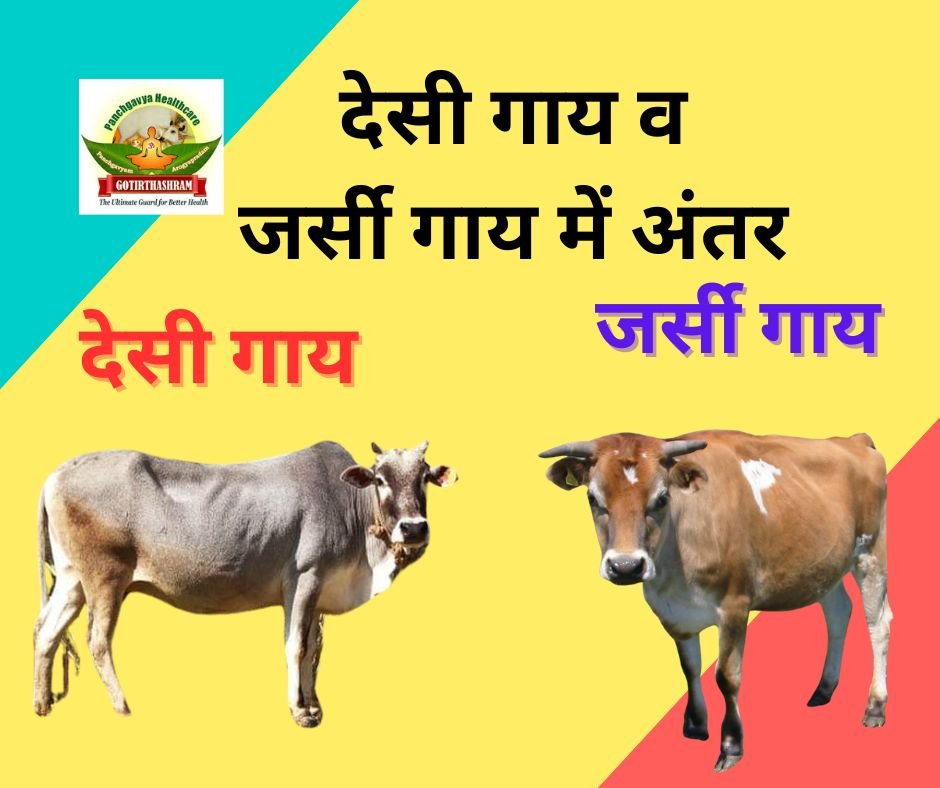
Desi Cow vs Jersey Cow: Key Differences, Milk & Traditional Significance
The cow has played an important role in Indian culture, agriculture, and daily life for many centuries. In various Indian communities, the native cow is regarded with deep respect as Gau Mata, and cow milk has long been considered a valuable source of nutrition.
Today, different types of cattle are raised throughout India, including native Indian breeds and foreign or crossbred cattle. Among these, Jersey cattle are well-known for producing a good amount of milk.
But what are the key differences between a Desi Cow and a Jersey Cow? How do they differ in terms of their origins, appearance, adaptability, and milk output?
This article aims to give a clear comparison of these two types of cattle, while also discussing the traditional importance of native Indian cattle.
What Is a Desi Cow?
The term Desi Cow typically refers to native Indian cattle breeds. These breeds are part of the Bos indicus group and have evolved over time in India's varied climates and farming conditions.
Some of the common Indian indigenous breeds are:
-
Gir
-
Sahiwal
-
Red Sindhi
-
Tharparkar
-
Hariana
-
Rathi
-
Kankrej
-
Badri
These breeds often have unique traits like a hump, loose skin, curved or long horns, and a broad forehead.
Indian native cattle are traditionally valued not only for their milk but also for their role in farming, manure production, rural livelihoods, and cultural practices.
What Is a Jersey Cow?
The Jersey cow is a foreign dairy breed that originated on the island of Jersey in the Channel Islands. It belongs to the Bos taurus group and is widely recognized for its dairy production.
Jersey cattle are generally smaller than many European dairy breeds and are known for producing milk that is rich in fat and protein.
In India, Jersey cattle are often used in crossbreeding programs to combine the traits of foreign dairy breeds with those of local cattle.
The performance of any Jersey or crossbred animal depends on several factors like genetics, food, climate, medical care, and how well the farm is managed.
Desi Cow vs Jersey Cow: Key Differences
While both types of cattle can be used for milk production, indigenous Indian cattle and Jersey cattle have different origins and characteristics.
Origin and Breed Type
Indigenous Indian cattle developed within the Indian subcontinent and include many breeds specific to different regions.
Jersey cattle originated outside India and were developed mainly as a specialized dairy breed.
This difference in their genetic background is one of the main distinctions between the two.
Physical Characteristics
Many native cattle breeds are easily identified by traits like a visible hump, a unique forehead shape, and horns that vary by breed.
Jersey cattle usually have a smaller, more compact build typical of dairy cows and usually do not have the prominent hump that is common in many Indian zebu breeds.
However, physical features can vary greatly between individual animals and breeds.
Climate Adaptation
Indigenous Indian cattle have been shaped by a wide range of Indian weather conditions. As a result, several native breeds are well-suited to local climates, although their performance still depends on proper feeding, water availability, shelter, and medical care.
Jersey cattle originated in a temperate climate. When raised in hotter regions, suitable shade, proper ventilation, water, good nutrition, and measures to manage heat stress are important.
Crossbred cattle may show different levels of adaptability depending on their genetic makeup.
Milk Production: Desi Cow vs Jersey Cow
One of the main reasons for the popularity of exotic dairy breeds in commercial dairy farming is their ability to produce more milk.
However, it is not correct to assign a single milk yield to every Desi or Jersey cow. Milk output can differ based on:
-
Breed and genetics
-
Food and nutrition
-
Stage of lactation
-
Age
-
Health
-
Farm management
-
Climate
-
Medical care
Some native breeds are very productive, and individual Jersey or crossbred cattle can also vary significantly in their milk output.
Therefore, statements like "every Desi cow produces 3–4 litres while every Jersey cow produces 12–14 litres" should not be taken as general rules.
Milk Composition and Nutritional Differences
The composition of milk is influenced by breed, genetics, feed, lactation stage, and how the animal is managed.
Jersey milk is known for having a relatively higher amount of milk fat and protein compared to milk from many other dairy breeds. Indigenous Indian cattle also produce milk with varying nutritional qualities depending on the breed.
It is more accurate to evaluate milk based on measurable qualities such as fat, protein, lactose, total solids, and fatty acid composition rather than stating one type is universally better or worse than another.
What About A1 and A2 Milk?
Discussions about milk protein often focus on beta-casein, especially the A1 and A2 forms.
Some indigenous Indian cattle populations have a high occurrence of the A2 beta-casein variant, while cattle genetics can differ significantly depending on the breed and individual animal.
However, claims that A1 milk is harmful or that A2 milk prevents certain diseases should not be treated as established medical facts. Research on the health effects of A1 and A2 beta-casein is still ongoing.
Therefore, consumers interested in A2 milk should look for verified information on breed, testing, sourcing, and processing rather than relying solely on breed labels.
Traditional Importance of Desi Cow
The role of indigenous cattle in India goes beyond milk production.
Traditionally, cows have been associated with:
-
Agricultural and rural livelihoods
-
Organic manure
-
Traditional farming methods
-
Panchgavya practices
-
Gau Seva
-
Cultural and religious traditions
-
Sustainable rural practices
This broader connection is one reason why indigenous cattle remain significant in Indian culture.
Why Are Jersey and Crossbred Cattle Common in Dairy Farming?
Milk production is a key factor for dairy farmers. Exotic and crossbred cattle are used in many dairy systems because certain genetic traits can lead to higher milk yields under proper management.
However, increased production also demands appropriate nutrition, healthcare, housing, water, and overall farm management.
The choice of cattle breed is therefore influenced by the farmer’s location, available resources, climate, market needs, and production goals.
Desi Cow and Jersey Cow: A Balanced Comparison
Rather than seeing the two breeds as simply "good" or "bad," it is more helpful to understand their differences and benefits in a balanced way.


